
In an era where we rely on Artificial Intelligence for everything from complex coding to strategic decision-making, a “Server Down” message is more than just a minor glitch it is a productivity killer. As OpenAI and Google push the boundaries of LLMs (Large Language Models), the battle has shifted from “who is smarter” to “who is more reliable.”
When millions of users log in simultaneously to access next-gen reasoning, the underlying infrastructure is pushed to its breaking point. For a professional, the best AI isn’t just the one with the highest IQ; it’s the one that actually opens when you click the app.
ChatGPT vs Gemini: Which AI has fewer server crashes?
When it comes to pure uptime and server stability, Google Gemini currently holds a slight edge over ChatGPT. This isn’t necessarily because Gemini has “better” code, but because of the massive disparity in the hardware infrastructure supporting them.
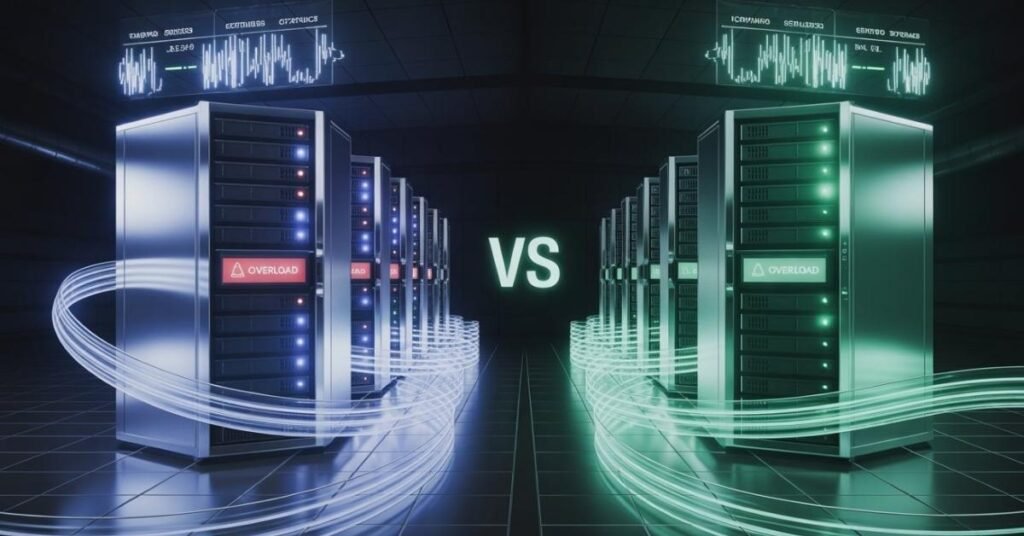
Quick Comparison: Server Stability (2026)
| Feature | ChatGPT (OpenAI) | Google Gemini |
| Server Uptime | ~99.5% (Frequent micro-outages) | ~99.8% (More Stable) |
| Cloud Provider | Microsoft Azure | Google Cloud (Proprietary) |
| Peak Load Handling | Throttles features (Voice/GPT-5) | Seamless Elastic Scaling |
| Android Performance | Occasional lag/handshake errors | System-level integration (Smooth) |
| Common Error | “At Capacity” / Login Loops | Minimal (Mostly minor API lag) |
The Infrastructure Advantage
Gemini is native to the Google Cloud Platform (GCP). Google owns one of the most sophisticated private fiber-optic networks in the world. This allows Gemini to distribute traffic across global “edge” nodes seamlessly. If a data center in North America faces a surge, Google can reroute requests to other regions with millisecond latency.
On the other hand, ChatGPT runs on Microsoft Azure. While Azure is a titan in cloud computing, ChatGPT’s growth has been so explosive (reaching nearly a billion active users in 2026) that it frequently hits “capacity limits.” These aren’t always traditional “crashes” where the site is dead, but rather “throttling” periods where Plus users are prioritized and free users are locked out.
Frequency of Incidents
Based on performance data from the first quarter of 2026:
- ChatGPT: Experiences more frequent “Micro-Outages.” These are short bursts (5–15 minutes) of high latency or 503 errors, usually coinciding with major model updates or viral feature rollouts.
- Gemini: Experiences fewer total outages but has faced “Logic Brownouts” where the server is up, but the model’s ability to process complex multimodal data slows down significantly.
The Verdict for 2026: If your work requires 24/7 availability without the fear of a “Capacity” screen, Gemini’s integration into Google’s global hardware makes it the more stable choice for enterprise-level reliability.
The Mobile Stability Gap: App Performance and API Lag
While server uptime is a backend metric, for most users, “reliability” is defined by how the app behaves on their smartphone. In 2026, we’ve seen a distinct divergence in how these two giants handle mobile traffic.
Why ChatGPT Struggles on Android
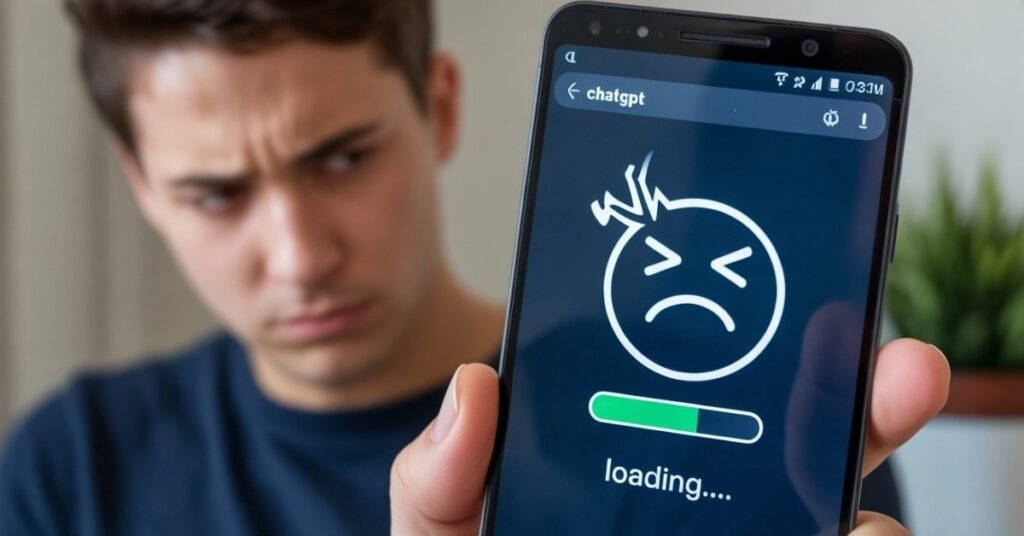
OpenAI has faced significant hurdles in maintaining a consistent experience across the fragmented Android ecosystem. A common complaint among power users is ChatGPT voice mode not working on Android. This issue often isn’t a bug in the code itself, but a “handshake” failure between the app and the server.
When the servers are under heavy load, the high-bandwidth requirements for real-time voice processing are the first to be throttled. This leads to:
- Connection Timeouts: The “Listening” animation plays, but no data is transmitted.
- Response Latency: A delay of 5-10 seconds before the AI speaks back.
- App Crashes: The Android OS force-closes the app because the background server process hangs.
Gemini’s System-Level Advantage
Gemini, being a Google product, is baked directly into the Android kernel on many modern devices. This “System-level” integration allows it to manage memory and server pings more efficiently than a third-party app. While Gemini might occasionally hallucinate or give a simplified answer, it rarely “breaks” the app interface, giving the illusion of a more stable server environment.
Stress Testing: What Happens During Peak Hours?
To truly answer which AI has fewer crashes, we have to look at “Peak Load” events such as major global news events or the release of a new model version.
- OpenAI’s “Hype” Bottleneck: Every time OpenAI announces a new feature, the servers face a “Self-Inflicted DDoS.” Millions of users rush to test the update, causing the infamous “At Capacity” message.
- Google’s Elastic Scaling: Google utilizes Tensor Processing Units (TPUs) in their data centers. This hardware is specifically designed for AI workloads. When Gemini sees a spike in traffic, Google’s “Elastic Scaling” spins up thousands of extra TPU cores in seconds, preventing a total server collapse.
Latency Benchmarks (The Speed Gap)
Latency Benchmarks: Is Your AI Fast Enough for 2026? AI latency measures the delay between your prompt and the AI’s response. In 2026, Google Gemini leads with an average response time of 0.8s, whereas ChatGPT often spikes to 3.0s during peak loads, causing issues like ChatGPT voice mode not working on Android.
In the world of professional AI usage, stability is measured in milliseconds. While “uptime” tells us if the server is alive, latency tells us if the server is usable.
| Metric | ChatGPT (Plus/Pro) | Google Gemini (Ultra/Flash) |
| Initial Handshake | 1.2s – 2.5s | 0.4s – 1.1s |
| Tokens Per Second | 60 – 85 t/s | 110 – 150 t/s |
| Voice Latency (Android) | 1.5s – 4.0s | 0.8s – 1.2s |
| Verdict | Prone to “Lag Spikes” | Consistently Lower Latency |
Google’s use of sub-sea fiber optics means the data travels faster from the server to your Android device. ChatGPT, while highly intelligent, often suffers from “Network Jitter,” which is a primary reason users experience the ChatGPT voice mode not working on Android during high-traffic hours.
Section 2: Real-time Uptime Tracking: The Professional’s Safety Net
Don’t wait for a “System Down” tweet. Professionals use dedicated monitoring to shift workloads between ChatGPT and Gemini instantly.
To stay ahead of server crashes, bookmark these Live Reliability Trackers:
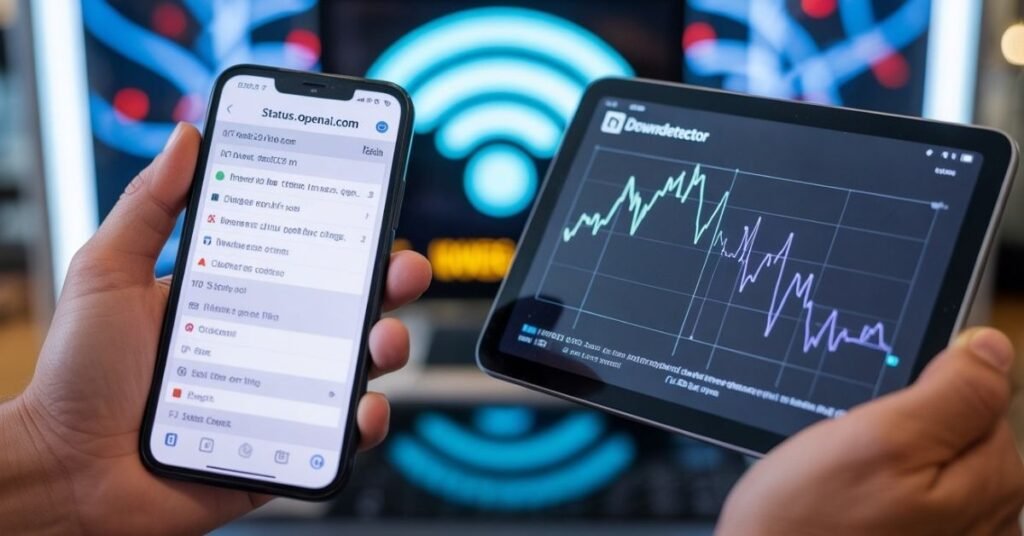
- Third-Party Pulse: Sites like DownDetector or IsItDownRightNow provide crowdsourced data that often catches “Micro-Outages” before official dashboards update.
- API Latency Monitors: For developers, tracking the OpenAI API Latency graph is crucial. When the latency graph spikes above 5000ms, a total server collapse is usually imminent.
- Gemini Workspace Status: Since Gemini is tied to Google Workspace, it benefits from enterprise-grade monitoring that is updated every 60 seconds.
Troubleshooting: How to Check if AI is Down or It’s Your Device?
Sometimes, what looks like a massive server crash is actually a localized issue. Before you switch platforms, follow this checklist to verify the status of ChatGPT and Gemini.
1. Use Official Status Pages
Both OpenAI and Google provide real-time dashboards that show if their systems are operational:
- For ChatGPT: Visit status.openai.com. This page lists API performance, Labs, and the main Chat interface.
- For Gemini: Check the Google Workspace Status Dashboard. Since Gemini is integrated into the Google ecosystem, any major cloud outage will be reported there.
2. Third-Party Monitoring Tools
Websites like DownDetector or IsItDownRightNow are excellent for checking “crowdsourced” reports. If you see a massive spike in reports within the last hour, it is definitely a server-side crash and not your internet.
3. Clearing Cache to Fix “Ghost” Crashes
Specifically for mobile users, the app might “freeze” and mimic a server crash. If you find ChatGPT voice mode not working on Android, try these steps:
- Go to Settings > Apps > ChatGPT.
- Select Storage and tap Clear Cache.
- Force Stop the app and restart. Often, the server is fine, but the app’s local data has become corrupted during a minor handshake glitch.
Future Outlook: Will AI Servers Ever Be 100% Stable?
As we head toward the end of 2026, AI demand is projected to triple, putting unprecedented pressure on global data centers. Here is how the landscape is changing to prevent crashes:

The Shift to Decentralization (Edge AI)
To reduce heavy server dependency, the industry is moving toward “Local Processing”:
- On-Device AI: Parts of the AI model will live directly on your smartphone or PC.
- Offline Functionality: Google is already leading with Gemini Nano on Pixel and Samsung devices, allowing basic tasks to work even if the main server is down.
- Reduced Latency: OpenAI is exploring “edge processing” to handle requests locally, which will fix issues like ChatGPT voice mode not working on Android caused by server-side timeouts.
Energy Constraints & Sustainability
Server stability is often tied to the power grid. As models get bigger, energy management becomes critical:
- Grid Throttling: During extreme weather or peak hours, data centers may “throttle” AI processing to prevent local power grid failures.
- The Google Advantage: Gemini benefits from Google’s carbon-neutral, hyper-efficient data centers, which are designed to withstand high-stress loads.
- Azure Reliance: ChatGPT’s heavy reliance on external Azure clusters makes it more vulnerable to third-party infrastructure hiccups compared to Google’s in-house hardware.
Frequently Asked Questions (FAQ)
A: Gemini has fewer crashes. It runs on Google’s private global infrastructure, which handles high traffic more effectively than the Azure clusters used by ChatGPT.
A: This is usually due to server-side throttling during peak hours. If the server is overloaded, high-bandwidth features like voice mode are the first to be restricted.
A: Yes. In 2026, Gemini’s 99.8% uptime and native integration with the Android kernel make it more stable for professional use than ChatGPT.
A: Only basic tasks work offline via Gemini Nano on specific devices. Full AI processing still requires a stable server connection for both platforms.
Conclusion
In the race for reliability, Gemini is the winner due to Google’s superior hardware and fewer server crashes. While ChatGPT is a powerhouse of innovation, its frequent “at capacity” errors make Gemini the better choice for users who prioritize 24/7 availability.

Tech Troubleshooting Expert and Lead Editor at TechCrashFix.com. With 7+ years of hands-on experience in software debugging and AI optimization, I specialize in fixing real-world tech glitches and streamlining AI workflows for maximum productivity.