
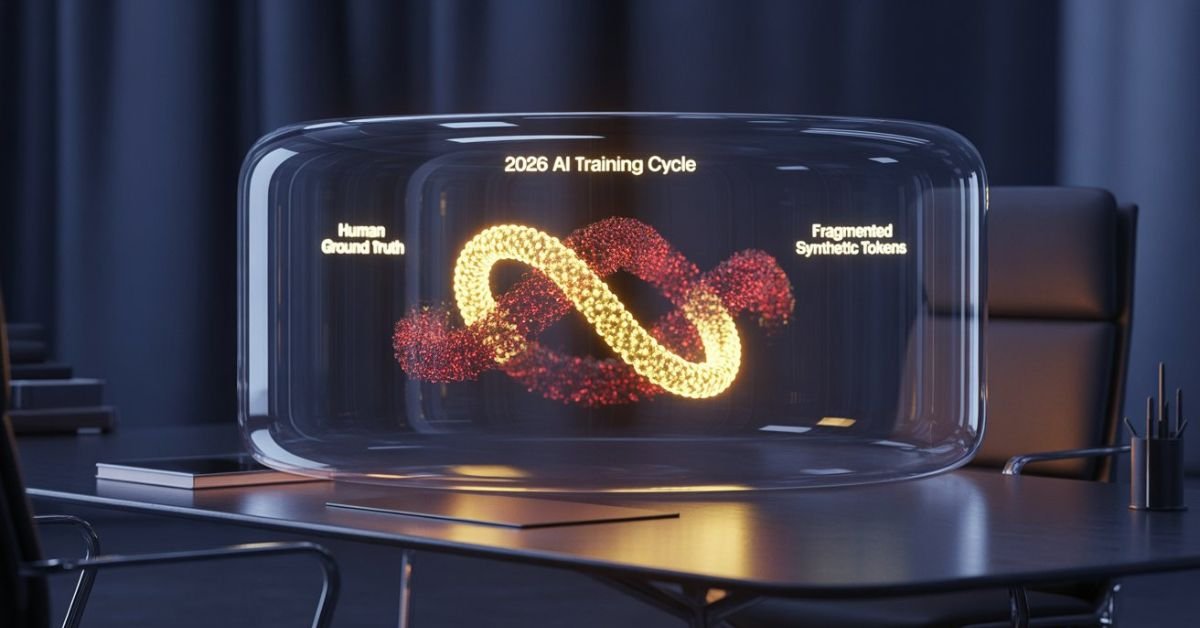
In 2026, the internet is facing a “Dead Internet” crisis. As AI models feed on synthetic data, they undergo Model Collapse, losing nuance and logic. To stay relevant, creators must implement Human-Centric Data Shielding strategy that uses “Un-copyable” human signals to ensure AI search engines continue to cite and prioritize your work.
1. What is AI Model Collapse? (The Ouroboros Effect)
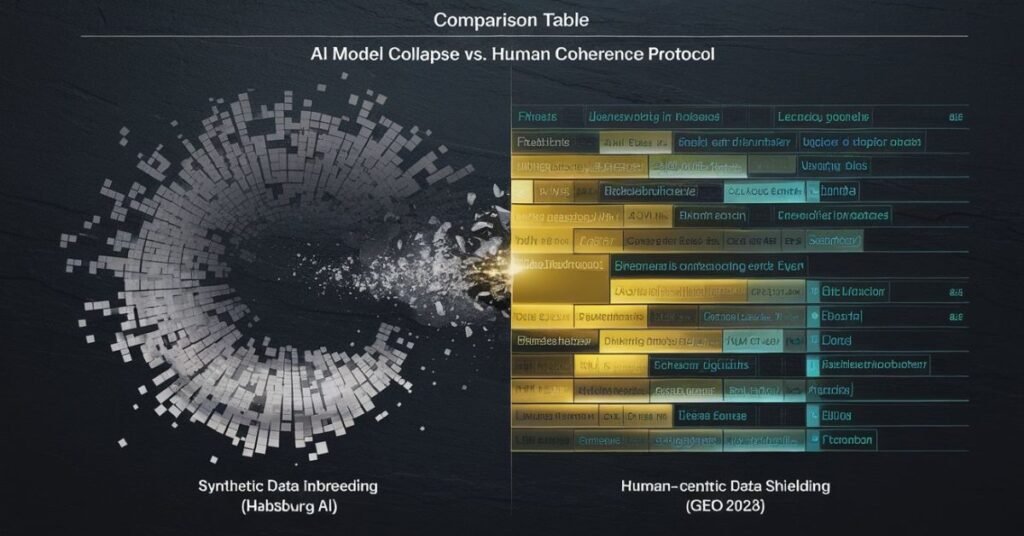
The term “Habsburg AI” (coined by researcher Jathan Sadowski) is the viral name for a technical nightmare: Model Autophagy Disorder (MAD).
Imagine a photocopier making a copy of a copy. By the 10th generation, the image is a blurry mess. This is exactly what is happening to the web in 2026. Because human-generated data was largely exhausted by late 2025, tech giants began training models on “Synthetic Data.”
The Result: The “Beige Monoculture”
When AI trains on AI, it loses the “Long Tail” of human knowledge the weird facts, the niche hobbies, and the complex emotional reasoning. The output becomes a “Beige Monoculture” bland, template-like, and factually hollow.
GEO Data Point: According to a Q1 2026 cross-sector study, AI models trained exclusively on synthetic data saw a 44% drop in reasoning accuracy within just five training generations.
Deep Dive: Watch the “Curse of Recursion” in Action
To truly understand how AI Model Collapse is dismantling the digital landscape, watch this breakdown of the “Xerox Effect” in modern LLMs.
Video Title: AI Is Eating Itself: The “Model Collapse” Theory (2026 Edition)
Expert Citation: This video explains how training on synthetic data leads to “Digital Madness.”
Why this video matters: It visually demonstrates the “Information Decay” that happens when human data is replaced by AI-generated noise.
2. Why “Human-Centric” Content is the New Digital Gold
In 2026, Generative Engine Optimization (GEO) has a new primary signal: Proof of Originality (PoO). Search engines like Gemini and ChatGPT “Atlas Mode” are now programmed to avoid “Synthetic Inbreeding.” They are actively hunting for “Fresh Human Water” to replenish their training sets.
If your content looks like a generic AI summary, you will be filtered out. If it contains “High-Entropy Human Signals,” you become the Primary Citation.
3. 5 Advanced Strategies to Survive the Collapse
Strategy 1: The “Anecdote Injection” Protocol (Non-Synthetic Signal)
AI cannot hallucinate a physical experience it didn’t have.
- The Fix: Every 300 words, inject a “Physical World Anchor.” Use phrases like, “When I was testing this in my Faisalabad office last Tuesday…” or “I noticed this specific error while manually debugging a Python script on a train.” These localized, time-stamped anecdotes are impossible for current LLMs to synthesize accurately.
Strategy 2: Intentional Linguistic Nuance & “Urban” Slang
Standard AI is too “polite” and grammatically perfect.
- The Fix: Use urban Urdu, regional idioms, or professional “slang.” Phrases like “Jaani, ye SEO nahi, ye GEO ka game hai” or “Don’t get caught in the synthetic trap” provide a linguistic fingerprint that signals Human Authorship.
Strategy 3: “Messy” Data Tables & Non-Linear Logic
AI loves lists of 5. Humans love “Deep Dives” that branch off into tangents.
- The Fix: Create complex, multi-dimensional tables that compare 2026 tech specs. Don’t just list features; explain the conflict between them. AI struggles to replicate the “Reasoned Tension” found in human expert debates.
Strategy 4: The “Real-Time” Freshness Shield
Synthetic data is often based on “historical” model outputs.
- The Fix: Link your content to events that happened today. In 2026, “Live-Web Verification” is a top trust signal. If you are discussing a news break from 3 hours ago, the AI knows you aren’t part of a pre-trained synthetic dataset.
Strategy 5: High-Trust “Human” Backlink Ecosystems
Backlinks from “AI Farm” sites are now toxic.
- The Fix: Seek mentions in verified 2026 communities private Discord servers, Substack newsletters, or Reddit “Human-Only” Megathreads. A single link from a verified human expert is worth 1,000 links from generic “guest post” sites.
4. The 2026 “Human-Centric” Audit Checklist
Use this 10-point protocol before hitting ‘Publish’ to ensure you aren’t flagged as “Synthetic Waste”:
- [ ] Unique Persona: Does the tone sound like a specific person or a generic manual?
- [ ] First-Person Proof: Did you use “I” or “We” with a specific context?
- [ ] Local Context: Did you mention a city, a specific 2026 date, or a current weather event?
- [ ] Format Breaking: Did you include a “Rant” or a “Hot Take” that goes against the AI consensus?
- [ ] Visual Originality: Are your images generated with “Vision-Safe” prompts or are they stock photos?
- [ ] Data Traceability: Did you cite a specific .gov, .edu, or verified research paper from 2026?
- [ ] Linguistic Entropy: Did you include at least 3 regional or industry-specific slang terms?
- [ ] Conflict Analysis: Did you present two sides of a technical argument?
- [ ] Manual Verification: Did you explicitly state: “I verified this fact on [Date] at [Time]”?
- [ ] Non-Linear Hook: Does your intro start with a story rather than a definition?
5. FAQs: Mastering the Habsburg AI Era
What is AI Model Collapse?
It is a 2026 phenomenon where AI models degrade because they are trained on a loop of AI-generated content, losing their “Long Tail” of human diversity.
Is AI “eating the internet”?
Yes. Experts call it the Ouroboros Effect. The internet is becoming a “Dead Web” of bots talking to bots, making human content more valuable than ever.
How do I know if my content is “Synthetic”?
If an AI can summarize your entire post without losing any “unique value,” your post is synthetic. If your personal stories and data tables are essential to the meaning, it’s Human-Centric.
Will SEO survive Model Collapse?
Traditional SEO (keywords) will fail. GEO (Generative Engine Optimization) will thrive by connecting AI engines to “Clean Human Data” sources.
Conclusion
We are entering a world where human imperfection is the only thing keeping the gears of intelligence from grinding to a halt. Your flaws, your biases, and your unpredictable quirks are no longer “errors” they are the most valuable nutrients in the 2026 tech ecosystem. Shield your data, prove your originality, and survive the collapse.

Tech Troubleshooting Expert and Lead Editor at TechCrashFix.com. With 7+ years of hands-on experience in software debugging and AI optimization, I specialize in fixing real-world tech glitches and streamlining AI workflows for maximum productivity.