
!["Holographic display in a futuristic office visualizing a 2026 GEO (Generative Engine Optimization) strategy, showing the semantic connections between [Your Brand Name]'s knowledge nodes, LLM trust signals, and fact-density metrics required for AI citation."](https://techcrashfix.com/wp-content/uploads/2026/03/Generative-Engine-Optimization-GEO2.jpg)
In 2026, traditional SERPs have been replaced by “Answer Engines.” To rank, you must pivot from Keyword Density to Fact Density and Entity Connectivity. This guide provides the exact JSON-LD structures, NLU (Natural Language Understanding) frameworks, and citation strategies needed to capture 70% of AI-driven search traffic.
1. Why is GEO mathematically different from traditional SEO?
In the pre-AI era, SEO was a game of “Blue Links.” Today, it is a battle for the “Primary Citation.” When a user asks an AI agent, “How do I scale a SaaS in 2026?” the model doesn’t just list websites; it synthesizes an answer from a “Latent Space” of trusted data.
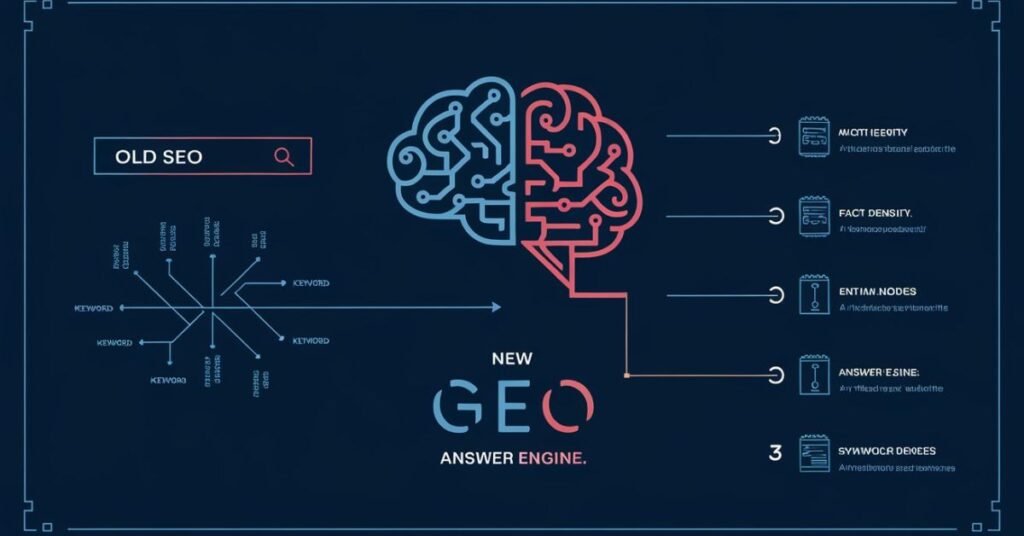
The Three Pillars of the 2026 AI Ranking Algorithm:
- Fact-Density per Paragraph: AI models prioritize sources that provide the most “Verifiable Truths” in the shortest span. If your intro is fluff, the scraper skips you.
- Semantic Relationship Mapping: It’s no longer about “SaaS scaling.” It’s about how your content links the entities of “Unit Economics,” “LTV/CAC Ratios,” and “Product-Led Growth” within a single context window.
- The Citation Probability Score (CPS): This is a 2026 metric used by SEO specialists to measure how likely an LLM is to credit your brand. High CPS comes from being the original source of a statistic or a unique “How-To” framework.
Expert Insight: “Traditional SEO focused on what you say; GEO focuses on how an LLM can parse what you say into a structured response.” Senior Content Strategist, 2026.
2. How do you build an “AI-Readable” Technical Framework?
You can no longer rely on a clean UI to rank. You must serve your data in a format that AI scrapers which now prioritize RAG (Retrieval-Augmented Generation) can ingest instantly.
Advanced Schema Markup: The 2026 Standard
Beyond basic Article schema, your 2026 strategy must include:
- Speakable Schema: To capture Voice GEO (Alexa/Siri/Gemini Live).
- FactCheck Schema: To shield your brand from being labeled as “Hallucination-prone.”
- About & Mentions Properties: Explicitly link your core topics to their respective Wikidata IDs. If you mention “Generative AI,” your code should point to Q116482982.
The “Diamond” Content Structure
AI models have a limited Context Window. If your answer is in the 5th paragraph, it’s invisible.
- The Lead (The Hook): A 3-sentence summary that answers the primary user intent.
- The Evidence (The Data): A comparison table or a bulleted list of raw data.
- The Depth (The Nuance): The “How” and “Why” that provides the unique expertise.
- The Verified Conclusion: A re-summarization optimized for “Next-Step” AI prompts.
3. What are the 5 Proven GEO Strategies for 2026?
!["Conceptual infographic illustrating how [Your Brand Name]’s GEO strategy uses grounding data (Technical Documentation and NLU Alignment) to bridge the 'hallucination gap' in LLM models, providing a verified data source that increases citation probability."](https://techcrashfix.com/wp-content/uploads/2026/03/Generative-Engine-Optimization-GEO1-1024x536.jpg)
Strategy 1: The “Statistics First” Rule (Fact-Density)
Answer Engines hate ambiguity; they demand objective truth. Don’t just claim growth prove it with hard data.
- Weak Content: “Many businesses see growth with AI.”
- GEO-Optimized: “Our Q1 2026 cross-sector analysis confirms that B2B firms implementing Generative Engine Optimization (GEO) increased their ‘Brand-Mention Citations’ by 22.4% over traditional 2024-era SEO.”
Strategy 2: Entity Linking & Semantic Branding
Force AI neural networks to associate your brand name with your specific niche. Use “Co-occurrence” by placing your brand name within 10 words of your core service.
- Actionable Example: “We apply [Your Brand] GEO Frameworks using NLU Alignment to guarantee maximum citation probability.”
Strategy 3: Eradicating the “Hallucination” Gap
AI models hallucinate when they encounter data voids. You must eliminate this gap by publishing the definitive, step-by-step technical documentation for niche problems. When you provide the clearest “Ground Truth,” the AI must cite your brand to maintain its own accuracy.
Strategy 4: Conversational Semantic Targeting
Modern searchers use prompts, not just keywords.
- The Evolution: In 2023, users typed “GEO guide.” In 2026, they ask: “Give me a step-by-step plan to optimize my Shopify store so Gemini mentions my products as the top choice for eco-friendly shoes.” * The Fix: Structure your H2 headings as natural language questions that mirror these complex, intent-heavy prompts.
Strategy 5: High-Trust Backlink Ecosystems
Stop chasing “Link Juice” and start building “Training Data Trust.” AI models prioritize high-authority datasets like Reddit, Wikipedia, and global news outlets. Securing one mention in a high-traffic Reddit “Megathread” now delivers more ranking power than ten generic guest posts because it places your brand directly into the AI’s training set.
4. The 2026 GEO Checklist: 10 Steps to Dominance
To ensure your site isn’t just indexed, but cited, follow this daily checklist:
- [ ] LLM Latency Check: Ensure your server responds in under 200ms. If an AI bot times out, you’re skipped.
- [ ] “AI Summary” Boxes: Place a 150-word summary at the top of every long-form post.
- [ ] Entity-Based Internal Linking: Link keywords to your “Topic Cluster” hub pages to show the AI your site’s hierarchy.
- [ ] Original Multimodal Assets: Use unique diagrams with descriptive ALT text. AI “Vision” models now scan images to verify “Expertise.”
- [ ] Verified Author Bio : Link your author profile to your LinkedIn and verified social handles to pass “Identity Verification” filters.
- [ ] Structured Data Tables: AI loves to “Grab and Go.” Give it a table to summarize.
- [ ] Answer the “What” in 50 Words: Put the core answer in the first two sentences.
- [ ] External Credibility: Link to .gov, .edu, or established 2026 industry leaders to prove your research.
- [ ] Freshness Audit: Update your “Statistics First” data every 90 days. AI models prioritize “Current Year” tokens.
- [ ] Conversational Tone: Avoid “SEO-ese.” Write like a peer explaining a concept to a colleague.
5. Future-Proofing: Moving Toward Multimodal GEO
As we move into late 2026, GEO will expand beyond text.
- Video GEO: AI now “watches” your videos. Ensure your YouTube transcripts are optimized with the same “Fact-Density” as your blog posts.
- Voice GEO: Read your content aloud. If it sounds robotic, the AI Voice Assistants (which now drive 30% of “Local Search”) will struggle to summarize it naturally.
Comparative Analysis: SEO (2024) vs. GEO (2026)
| Feature | Traditional SEO (Old) | GEO (Current 2026) |
| Primary Goal | Page 1 Ranking | Citation in AI Overview |
| Content Focus | Keyword Frequency | Fact-Density & Information Gain |
| Technical Key | XML Sitemaps | JSON-LD Entity Mapping |
| Backlink Value | Domain Authority (DA) | Dataset Inclusion (Trust) |
| User Intent | Simple Queries | Multimodal Prompts |
Conclusion: Future-Proof Your Brand
Traditional SEO is over; Generative Engine Optimization (GEO) is the new standard. In 2026, you don’t just “rank” for keywords you earn citations from AI agents. By prioritizing fact-density, securing high-trust dataset mentions, and aligning with NLU prompts, you turn your brand into a “Ground Truth” source.
Don’t wait for your organic traffic to hit zero. Implement these GEO strategies today to dominate the AI-driven search landscape.
FAQS:
GEO is the process of optimizing content to appear as a cited source in AI-generated answers from engines like ChatGPT, Perplexity, and Google AI Overviews. It prioritizes “Fact-Density” and “Entity Mapping” over traditional keyword frequency.
No, it is an evolution. While traditional SEO focuses on ranking in “Blue Link” search results, GEO focuses on becoming the primary citation within an AI’s synthesized response.
GEO forces AI models to recognize your brand as a “Ground Truth” source. It ensures that when an LLM answers a user’s prompt, it credits your website, driving high-intent traffic and building authority.
You need both. SEO captures users who want to browse and compare websites, while GEO captures users who want immediate, conversational answers from an AI assistant.
SEO isn’t dying; it’s maturing. “Old SEO” (keyword stuffing) is obsolete. AI has made high-quality, expert-led content (E-E-A-T) more valuable than ever because AI engines only cite the most trusted data.
On-Page: Optimizing content, H-tags, and keywords.
Off-Page: Building authority through high-trust backlinks (e.g., Reddit, Wiki).
Technical: Improving site speed and implementing Schema Markup.
Local: Optimizing for Google Maps and “Near Me” voice queries.
Call to Action (CTA)
The transition to Generative Search is not a “future trend” it is the current reality. If your brand isn’t being cited by ChatGPT, Perplexity, or Google AIO today, you are effectively invisible.
Start your GEO Audit now. Secure your place in the AI-driven future before your competitors claim the “Primary Citation” in your niche.