
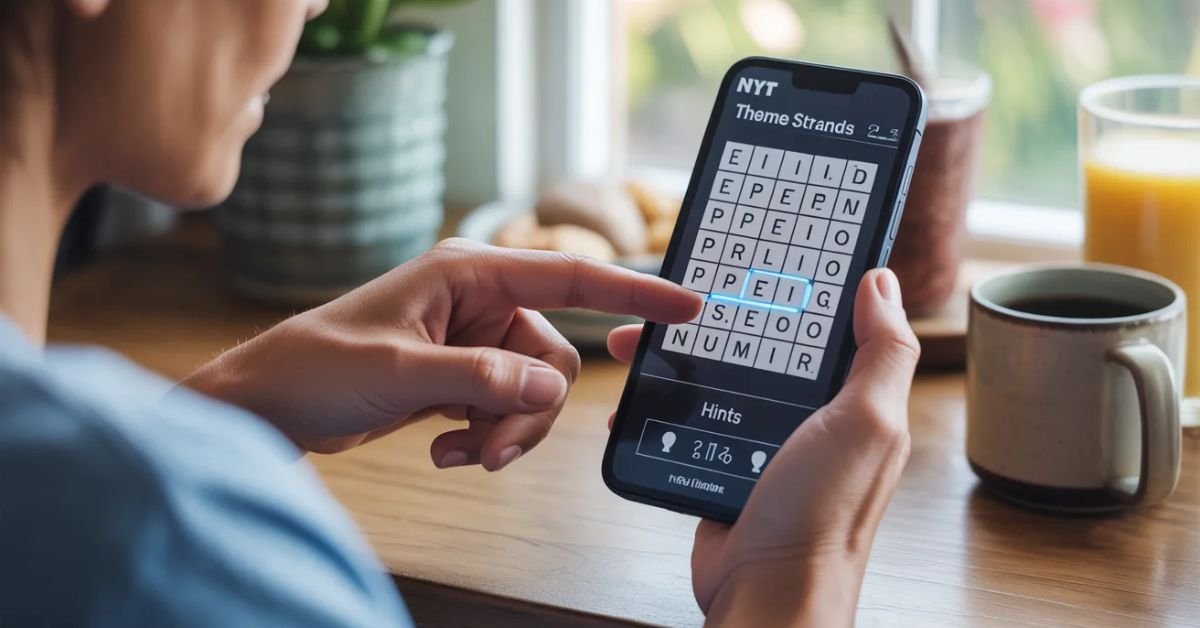
If you’ve ever stared at a 6×8 grid of letters wondering what on earth you’re supposed to do you’re not alone. NYT Strands hooked millions of players after its official launch in March 2024, and by 2026, it’s become just as much a part of people’s morning routines as Wordle or Connections. The problem? The game doesn’t exactly hold your hand. There’s no tutorial pop-up, no walk-through, just a grid, a cryptic theme clue, and your brain.
I’ve been playing NYT Strands every single day since its beta launch, and I’ve tested every strategy you’ll find in this guide personally. This isn’t a rehash of the official rules page. This is a how to play NYT Strands breakdown that will actually make you better at the game fast.
What Are NYT Strands? (And Why Everyone’s Talking About It)
NYT Strands sits in a sweet spot between a word search and a crossword. It’s published daily by The New York Times Games team, drops at midnight Eastern Time, and lives on the NYT Games app (iOS and Android) as well as the NYT website.
The core idea: you’re given a 6×8 grid packed with 48 letters, a daily theme hint, and your job is to find all the hidden words that relate to that theme. Sounds simple. It isn’t at least not until you understand the mechanics properly.
What makes Strands different from a regular word search is that every single letter on the board gets used. There are no leftover tiles. Theme words highlight blue when found, and there’s one special word called the Spangram that highlights yellow. Miss the Spangram and you’ve missed the whole puzzle.
In my experience, most players who struggle with Strands aren’t bad at word games; they just haven’t learned the Spangram-first approach. More on that below.
Why NYT Strands Confuses New Players (The Real Reason)
Let me be upfront: the game’s learning curve catches people off guard because it looks deceptively like something familiar. You see a grid of letters and assume you’re hunting for random words. That’s the wrong mental model entirely.
The confusion usually comes from three things:
1. Letters can connect in any direction. Unlike a traditional word search where words go in straight lines, Strands lets letters connect horizontally, vertically, and diagonally and words can bend, curve, and zigzag across the board. A single word might snake halfway across the grid.
2. The theme isn’t always obvious. The daily hint is often a pun, a cultural reference, or intentionally vague. During my testing, I’ve had themes that took two minutes to click and others that took fifteen same skill level, wildly different hint clarity.
3. The Spangram concept is totally new. No other mainstream word game uses it. Players who don’t know what a Spangram is will find half the board impossible to decode.
Once those three things click, the game opens up like a different puzzle entirely.
How to Access NYT Strands in 2026
Before you can play, you need to get there. Here’s exactly how:
Step 1: Go to the NYT Games App or Website
- On mobile: Download the New York Times Games app (free on iOS and Android).
- On desktop: Visit nytimes.com/games/strands directly.
Step 2: Sign In or Create an Account A free NYT account is enough to play Strands. You don’t need a paid subscription. Sign up with your email, verify it, and you’re in.
Step 3: Find Strands in the Games Menu On the app, tap the grid icon in the bottom nav and scroll to Strands. On the website, it’s listed under Games alongside Wordle, Connections, and the Mini Crossword.
Step 4: Start Today’s Puzzle The puzzle refreshes every day at midnight Eastern. If you see yesterday’s completed grid, tap “New Puzzle” or wait for the refresh. Each puzzle is numbered as of late May 2026, we’re in the #818 range.
How to Play NYT Strands: Step-by-Step Rules Explained
Here’s the full ruleset broken down the way I wish someone had explained it to me on day one.

Step 1: Read the Theme Clue Carefully
At the top of the board, you’ll see a short phrase that’s your theme hint. It’s deliberately cryptic. Don’t rush past it. Spend 20–30 seconds genuinely thinking about what category of words it might point to.
For example, a recent theme clue was “E-I-E-I-O” which pointed to farm animals (from the Old MacDonald nursery rhyme). The answers were CHICKENS, COWS, DUCKS, GOATS, HORSES, PIGS, and SHEEP. The Spangram was FARMANIMALS. Once you see the connection, the whole board reorganizes in your head.
Step 2: Understand How to Form Words
There are two input methods:
- Swipe: Press and drag your finger (or mouse) through connected letters to form a word. Release to submit.
- Tap: Tap individual letters one at a time to build a word, then double-tap the last letter to confirm.
Letters must be adjacent horizontally, vertically, or diagonally. Each letter can only be used once per word, and words can travel in any direction including curves and zigzags.
Step 3: Hunt for the Spangram First
This is the single biggest strategic tip I can give you. The Spangram is the one word (occasionally a two-word phrase) that:
- Names or describes the theme of the puzzle
- Physically touches two opposite sides of the 6×8 board (top-to-bottom OR left-to-right edges)
- Highlights in yellow when found
It doesn’t have to start or end at a corner, just any point along opposite edges. In my experience, most Spangrams are 8 or more letters long. Scan the board’s edges first and look for longer chains of letters. When you find it, the remaining theme words become dramatically easier to isolate.
Step 4: Find All Theme Words
Theme words are the group of answers directly connected to the day’s theme. When you find one correctly, it lights up blue and those letters are locked and no longer available for other words. Theme words never overlap. When every letter on the board is colored either blue or yellow, you’ve solved the puzzle.
Step 5: Use the Hint System Wisely
Stuck? You can earn hints but you don’t get them for free. Here’s how the hint economy works:
- Find non-theme words (real English words that don’t belong to the theme) of 4 letters or more
- Every 3 non-theme words you find fills up one hint
- Activate the hint, and it highlights the letters of one theme word on the board
If a hint is already active on the board, the next hint will also reveal the order in which to trace that word’s letters. One trick I discovered during testing: use hints as soon as you earn them. The hint bar doesn’t stack beyond one, so banking non-theme words past three is wasteful.
Step 6: Check Your Results
Once solved, a results screen appears. It shows:
- A lightbulb icon for each hint you used
- Blue circles for each theme word found (in order)
- A yellow circle for the Spangram
- A “Perfect!” badge if you finished with zero hints
You can also share your result grid similar to Wordle which displays your solve path without spoiling the words for others.
Spangram Deep Dive: The One Mechanic That Changes Everything
I want to spend a moment here because the Spangram is genuinely the engine of this game and most guides treat it as an afterthought.
The Spangram is named by combining “span” (it spans the board) and “pangram” (a nod to Spelling Bee’s pangram mechanic). Think of it as the anchor word that gives meaning to all the others.
How to spot a Spangram faster:
- Scan the edges first. Every Spangram starts somewhere on one edge and ends somewhere on the opposite edge. Look for letter clusters along the top/bottom rows or leftmost/rightmost columns.
- Look for longer chains. Most Spangrams are compound words or phrases FARMANIMALS, SCAVENGERHUNT, HOTDIGGITYDOG. The longer the word, the more of the board it’ll traverse.
- Use the theme clue as a compass. If the theme clue is “That’s dedication”, you’re looking for a word that literally embodies that concept. Work backwards from meaning to letters.
I found that on days when I couldn’t crack the Spangram within the first few minutes, treating it as a crossword “across” clue and imagining what single phrase could capture the theme usually got me there within another minute or two.
Pro Strategies to Solve NYT Strands Without Using Hints

After hundreds of sessions, here are the tactics that genuinely separate fast solvers from frustrated ones:
1. Think in categories, not individual words. If the theme is related to cooking, brainstorm 10 cooking-related words before you even look at the grid. Then find those specific words rather than scanning aimlessly.
2. Work from the Spangram outward. Find the Spangram, lock those letters, and now you’ve narrowed down where theme words can live on the remaining board space.
3. Use the edges as anchors. Since the Spangram runs edge-to-edge, once found it splits the board into zones. Theme words tend to cluster within those zones.
4. Don’t get attached to a word path. Letters can zigzag in ways that feel unnatural. If you’re confident a word exists but can’t trace it, try starting from a different letter in that word.
5. Non-theme words are your friends. If you’re hopelessly stuck, intentionally hunt for common 4–5 letter words (STOP, LATE, ROSE, etc.) to farm hints. It feels like cheating. It isn’t part of the designed hint system.
NYT Strands vs. Other NYT Games: How It Compares
| Feature | NYT Strands | Wordle | Connections | Mini Crossword |
| Grid Size | 6×8 (48 letters) | 5×6 (5-letter word) | 4×4 (16 items) | 5×5 squares |
| Daily Limit | 1 puzzle/day | 1 word/day | 1 puzzle/day | 1 puzzle/day |
| Time to Complete | 5–20 min | 2–5 min | 3–8 min | 2–10 min |
| Subscription Needed | No (free) | No (free) | No (free) | No (free) |
| Hint System | Earn via gameplay | Color feedback | None | None |
| Unique Mechanic | Spangram | Process of elimination | Categorical grouping | Clue-based solving |
| Difficulty Level | Medium–Hard | Easy–Hard | Medium | Easy–Medium |
| Sharable Results | Yes | Yes | Yes | No |
| Streak Tracking | Yes | Yes | Yes | No |
From my testing, Strands demands the most lateral thinking of any NYT game. Wordle is methodical, Connections is categorical, the Mini Crossword is knowledge-based but Strands asks you to hold a theme in mind while spatially navigating a board. It’s its own thing.
Common Mistakes New Players Make (And How to Avoid Them)
Mistake #1: Ignoring the theme clue. I’ve watched new players dive straight into the grid hunting for any word they recognize. The theme clue isn’t decorative, it’s the key. Read it, sit with it, connect it to a category before touching the board.
Mistake #2: Chasing short words. Non-theme words must be 4+ letters to count toward hints. Typing 3-letter words like “CAT” or “RUN” wastes time and gives you nothing.
Mistake #3: Forgetting words can zigzag. During my early days playing, I missed theme words repeatedly because I was thinking in straight lines. Strands is not a straight-line game. Let your tracing follow the letters, not your expectations.
Mistake #4: Not using hints promptly. The hint bar doesn’t let you bank more than one hint at a time. Once it’s full, additional non-theme words are useless until you spend the hint. Cash them in immediately.
Mistake #5: Rage-quitting before re-reading the theme. If you’re completely lost, the theme clue is almost always the unlock. Re-read it as if it’s a riddle, not a label. Puns, pop culture references, and double meanings are all fair game.
How the Scoring and Sharing Works
Strands doesn’t have a numerical score it tracks performance through its results summary:
- No hints used: “Perfect!” the holy grail for competitive players
- Hints used: Lightbulb icons indicate how many
- Word order: Blue circles show the sequence in which you found theme words; the yellow circle marks the Spangram’s position in your solve order
The share button generates a grid of colored circles (no text spoilers) that you can paste anywhere Twitter/X, group chats, Reddit’s r/NYTStrands community. It’s designed to let you brag or commiserate without ruining the puzzle for anyone who hasn’t played yet.
FAQ: People Also Ask About NYT Strands
Are NYT Strands free to play?
Yes, completely free. You need a New York Times account (also free) to sign in, but Strands does not require a paid NYT Games subscription. You can access it on the NYT Games website or the NYT Games app on iOS and Android with zero cost.
What is the Spangram in NYT Strands?
The Spangram is a special word (or two-word phrase) that spans the entire 6×8 board by touching two opposite edges either top-to-bottom or left-to-right. It describes or names the theme of the day’s puzzle and highlights in yellow when found. Every Strands puzzle has exactly one Spangram.
How do you get hints in NYT Strands?
You earn hints by finding non-theme words of 4 letters or more in the grid. Every three valid non-theme words fills the hint meter by one full hint. When you activate a hint, it highlights the letters belonging to one theme word. If a hint is already active, the next hint will additionally reveal the letter order for tracing that word.
Can you play old NYT Strands puzzles?
The official NYT app only serves the current day’s puzzle. However, fan-built archives like Strands Unlimited (playstrandsnyt.com) maintain extensive archives of past puzzles going back to the game’s launch, with many hosting 400–500+ past games for free. These are unofficial but widely used by the community.
Final Thoughts: Is NYT Strands Worth Playing Daily?
Absolutely and I say that as someone who has played every major NYT word game since Wordle exploded in 2022. What makes how to Play NYT Strands worth learning properly is that the game genuinely rewards pattern recognition and thematic thinking in a way nothing else does. It’s not just vocabulary, it’s spatial reasoning, cultural knowledge, and lateral thinking all wrapped into one daily puzzle.
The learning curve is real. Your first week might feel like you’re just farming non-theme words for hints on every single puzzle. That’s fine. By week two, you’ll start spotting Spangrams within the first minute. By month one, “Perfect!” runs become a realistic daily goal.
Start with the Spangram. Always read the theme clue twice. And give the words room to zigzag.
Disclaimer
This article is published for educational and informational purposes only. TechCrashFix.com is not affiliated with The New York Times Company. All game mechanics, features, and trademarks related to NYT Strands belong to The New York Times. Game rules and features may change over time; refer to the official NYT Games platform for the most current information.
Found this guide helpful? Bookmark TechCrashFix.com for daily tips on apps, games, and tech troubleshooting.